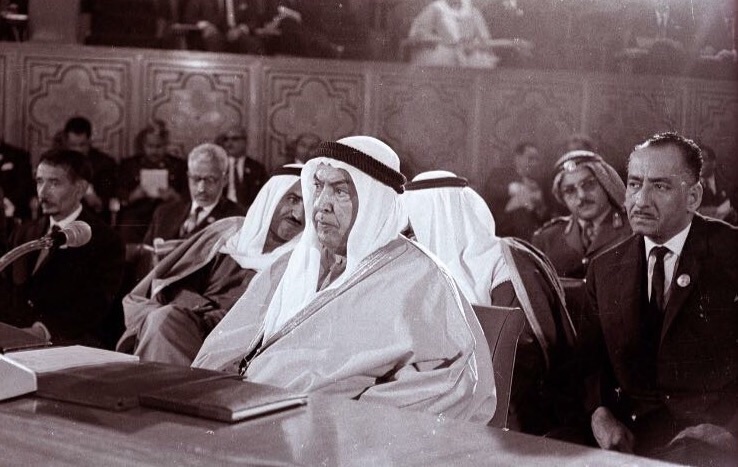
politicalphishing.com – Emir Abdullah Al-Salim Al-Sabah, who ruled from 1950 to 1965, is remembered as the “Father of Modern Kuwait” and the leader who oversaw the country’s transition from a British protectorate to an independent sovereign state. As the 11th ruler of Kuwait and the first emir after independence, his reign marked a turning point in the country’s history. He implemented significant political, economic, and social reforms, laying the foundation for modern governance, education, and infrastructure development. Emir Abdullah’s forward-thinking vision helped position Kuwait as a progressive state in the Gulf region.
Early Life and Ascension to Power
Born in 1895, Abdullah Al-Salim was a member of the Al-Sabah ruling family, which had governed Kuwait since the 18th century. He was the eldest son of Salim Al-Mubarak Al-Sabah, and as a senior member of the ruling family, Abdullah held various governmental positions prior to becoming emir. He served as head of the finance department, which gave him insights into the country’s economic affairs and the importance of diversifying its revenue streams, particularly in light of the growing oil industry.
In 1950, following the death of his cousin, Sheikh Ahmad Al-Jaber Al-Sabah, Abdullah Al-Salim ascended to the throne as the Emir of Kuwait. His reign marked a period of significant transformation, as Kuwait’s economic and political landscape began to change rapidly due to the increasing revenues from oil production.
Political Reforms and Independence
One of Emir Abdullah’s most notable achievements was guiding Kuwait toward independence from British control. Since the late 19th century, Kuwait had been a British protectorate, and Abdullah sought to end this arrangement in favor of full sovereignty. His diplomatic efforts culminated in the signing of the Anglo-Kuwaiti Agreement on June 19, 1961, which formally ended the British protectorate status and recognized Kuwait as an independent state.
With independence achieved, Emir Abdullah was committed to building the institutional framework necessary for a modern state. In 1962, he introduced Kuwait’s first written constitution, which was one of the most progressive in the Arab world at the time. The constitution established Kuwait as a constitutional monarchy with an elected parliament, known as the National Assembly, which gave Kuwaiti citizens a voice in governance. The introduction of parliamentary elections and a system of checks and balances reflected Emir Abdullah’s vision of shared governance and political participation.
Economic Reforms and the Oil Boom
Emir Abdullah’s reign coincided with Kuwait’s rapid transformation into a wealthy oil-producing state. Oil had been discovered in Kuwait in 1938, and by the 1950s, oil revenues were significantly boosting the country’s economy. Emir Abdullah understood the importance of using this newfound wealth to improve the standard of living for his people and to modernize the country’s infrastructure.
Under his leadership, Kuwait experienced a period of rapid urbanization, with the construction of modern roads, schools, hospitals, and housing developments. The oil revenues allowed Kuwait to invest heavily in public services, including healthcare and education, which improved the quality of life for Kuwaitis and positioned the country as a leader in social welfare among Gulf states.
At the same time, Emir Abdullah implemented measures to diversify Kuwait’s economy and reduce its dependency on oil exports. He established the Kuwait Fund for Arab Economic Development in 1961, which aimed to promote economic cooperation and development projects across the Arab world. This move not only strengthened Kuwait’s international ties but also demonstrated Emir Abdullah’s commitment to regional solidarity and development.
Social Reforms and Education
Emir Abdullah was a strong advocate for social reform, particularly in the areas of education and healthcare. He believed that education was key to the future of Kuwait, and during his reign, he expanded the country’s educational system to provide free, state-funded education for all citizens. The establishment of schools and vocational training centers helped create a well-educated workforce that could contribute to the country’s modernization and development.
In addition to education, Emir Abdullah invested in healthcare, with the construction of hospitals and clinics that provided free medical services to the public. His focus on social welfare reflected his desire to improve the overall well-being of the Kuwaiti population, making healthcare and education central to his vision of a prosperous, progressive Kuwait.
Foreign Relations and Regional Diplomacy
Throughout his reign, Emir Abdullah was committed to maintaining Kuwait’s sovereignty and fostering diplomatic relations with other Arab states and the international community. Following independence, Kuwait joined the United Nations in 1963, marking its official entry into the global diplomatic arena.
In the region, Emir Abdullah was a strong proponent of Arab unity and cooperation. Kuwait played an active role in the Arab League, and Emir Abdullah supported various pan-Arab causes, including the Palestinian struggle for independence. His establishment of the Kuwait Fund for Arab Economic Development demonstrated his belief in economic cooperation as a means of strengthening regional ties and promoting stability in the Arab world.
Emir Abdullah’s diplomatic acumen was also evident in his handling of the territorial dispute with Iraq. Shortly after Kuwait gained independence, Iraq claimed sovereignty over Kuwait, arguing that it was historically part of its territory. Emir Abdullah navigated this crisis with a measured and diplomatic approach, seeking support from both Arab allies and the international community to affirm Kuwait’s independence.
Legacy and Death
Emir Abdullah Al-Salim Al-Sabah’s reign came to an end on November 24, 1965, when he passed away while delivering a speech at the National Assembly. His death marked the end of a transformative era for Kuwait, but his legacy as the “Father of Modern Kuwait” continues to shape the nation’s identity.
He is remembered as a forward-thinking leader who championed political reform, modern governance, and social welfare. His introduction of the constitution, the establishment of the National Assembly, and his focus on education, healthcare, and economic diversification laid the foundation for Kuwait’s stability and prosperity in the years that followed.
Conclusion
Emir Abdullah Al-Salim Al-Sabah’s leadership from 1950 to 1965 was a pivotal period in Kuwait’s history. As the first emir of an independent Kuwait, he guided the country through a time of profound change, from its emergence as a sovereign state to its transformation into a modern, oil-rich nation. His legacy of constitutional reform, economic development, and social progress continues to influence Kuwait’s path forward as a leading Gulf state.