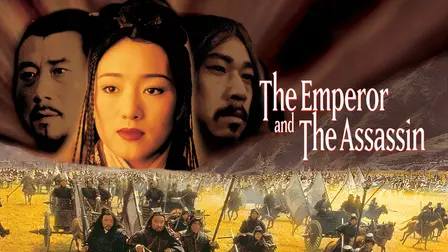
politicalphishing.com – “The Emperor and the Assassin” (1998), directed by Chen Kaige, is a Chinese historical drama that explores the tumultuous period leading up to the unification of China under the Qin dynasty. The film stars Gong Li, Zhang Fengyi, and Li Xuejian, and it intertwines political intrigue with personal drama to tell a complex tale of power and betrayal.
Plot Overview
Set in the 3rd century B.C., the film centers on Ying Zheng (Li Xuejian), the ambitious King of Qin, who dreams of unifying China under his rule. To achieve this, he devises a strategic plot involving his concubine, Lady Zhao (Gong Li), and a renowned assassin, Jing Ke (Zhang Fengyi). Lady Zhao is sent to the Yan kingdom to recruit Jing Ke for a mission to assassinate Ying Zheng, thereby providing a pretext for war. However, as the plan unfolds, Lady Zhao’s loyalties and Jing Ke’s motivations become increasingly conflicted, leading to a dramatic and tragic conclusion.
Themes and Symbolism
“The Emperor and the Assassin” delves into themes of loyalty, ambition, and the moral complexities of leadership. It explores the ethical dilemmas faced by its characters, who are torn between personal desires and political duties. The film also reflects on the brutal realities of power and the cost of unification, questioning the sacrifices made in the name of a greater good.
Visual Style
Chen Kaige’s direction is complemented by the film’s striking cinematography, which captures the grandeur of ancient China with sweeping landscapes and intricately designed sets. The use of color and composition enhances the storytelling, drawing viewers into the emotional and historical depth of the narrative.
Impact and Reception
Upon its release, “The Emperor and the Assassin” received critical acclaim for its ambitious scope and powerful performances, particularly by Gong Li and Zhang Fengyi. It won the Technical Grand Prize at the 1999 Cannes Film Festival and was noted for its historical accuracy and dramatic intensity. The film’s exploration of ancient Chinese history resonated with audiences, offering a profound look at a pivotal moment in China’s past.
Conclusion
“The Emperor and the Assassin” stands as a significant work in Chinese cinema, blending historical authenticity with compelling drama. Its exploration of power, sacrifice, and human emotion continues to captivate viewers, making it a timeless epic that reflects on the complexities of history and leadership.